A new threat to local rivers and streams has emerged in DuPage County: Hydrilla verticillata, commonly known as Hydrilla.
A Homeowners Association on Ginger Creek in Oak Brook recently notified the Illinois Department of Natural Resources (IDNR) that they had observed hydrilla within their lakes. This is the first reporting of Hydrilla in the Salt Creek watershed. Hydrilla, native to Asia, is an aggressive invasive plant that is often found in aquariums. Improper disposal of aquariums has allowed this invasive species to enter waterways, where it thrives and disrupts ecosystems.
This discovery underscores the critical importance of preventing the spread of invasive species. Simple actions, like avoiding the dumping of plants or animals into rivers, creeks, or ponds, can protect local ecosystems from widespread disruption.

The current extent of invasive Hydrilla. The aquatic plant was first introduced in Florida and has spread aggressively from there (https://www.eddmaps.org/).
Hydrilla’s Impact on Rivers and Streams
Hydrilla is problematic because it grows exceptionally well here. It can grow rapidly with minimal resources, outcompeting native plants even in poor habitat. Hydrilla regrows from small fragments, much like the Hydra from Greek mythology, so manual collection methods tend to only increase its dispersal. Additionally, it produces tubers that grow at the bottom of lakes and rivers, allowing it to overwinter and survive other harsh conditions.

Tubers that grow on the roots of Hydrilla. These tubers are small and often white. They enable the plant to survive harsh conditions. Image credit: Leslie J. Mehrhoff, University of Connecticut, Bugwood.org
Hydrilla is also tolerant of saline waters, which is a growing issue in local waterways. Salt concentrations in the watersheds are increasing over time, harming native aquatic life. This emerging pollutant, combined with an invasive species that isn’t harmed by salinity, compounds the danger of Hydrilla.
Hydrilla’s explosive growth chokes out native aquatic plants and disrupts the food chain, depriving fish and invertebrates of their natural resources. It clogs up rivers and lakes to the point that it affects the water’s pH and dissolved oxygen, which can lead to fish kills. Given its aggressive expansion, severe ecological impacts, and difficulty of removal, finding hydrilla early and keeping it out of our watersheds is critical.
Hydrilla in Illinois Waterways
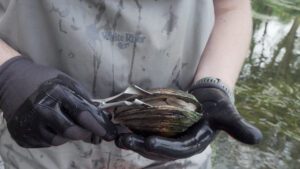
IDNR has been investigating the extent of Hydrilla in the watershed. Staff from The Conservation Foundation joined three IDNR employees to confirm its presence near the Salt Creek mainstem. Armed with waders and double-headed rakes attached to ropes, the team employed a unique method of searching for Hydrilla in lakes. The crew stood ashore and launched the rakes into the water, let them sink, and pulled them back to shore. The rakes dragged up plants, trash, and debris, which the team carefully examined for evidence of Hydrilla. After scouring one section of the bank, they moved along the bank and repeated the process.
The search, which covered several lakes as well as sections of Salt Creek and Ginger Creek, lasted most of the day. Thankfully, no signs of Hydrilla were found. However, since it was late in the season, the invasive plant could still be hidden. While there is a good chance that Hydrilla has not yet migrated out of Ginger Creek and into Salt Creek, only a small area was surveyed and additional monitoring will be necessary. IDNR is continuing to monitor the stream reach and is planning to apply for grant funding to address the invasive plant.
Invasive species are significantly easier to manage when you catch them early. Removing a single plant is far easier than tackling widespread infestations across miles of rivers and dozens of lakes. However, finding these plants before they become established is challenging. Even a small colony can go unnoticed until it becomes a problem. Short of going in with a team of scuba divers and searching every square foot, it is impossible to be certain Hydrilla hasn’t spread downstream.

A large mass of Hydrilla attached to a boat trailer. When Hydrilla overgrows a lake, it is easy for it to catch on aquatic equipment. If not cleaned off, it will spread to other lakes and rivers Image credit: https://seagrant.noaa.gov/north-carolina-coastal-collaborations-focus-on-invasive-hydrilla/
Identify and Prevent the Spread of Hydrilla
Hydrilla can be identified best by its leaves. They are typically in whorls of five or more along its long, slender stems. The leaves also have tiny serrations and can feel rough on your skin when you pull the leaves between your fingers. There is another plant, American Elodea or Elodea canadensis, which looks similar and is native. Elodia lacks the leave serrations, and has only three leaves in each whorl.

Hydrilla Verticillata. Invasive aquatic plant with long slender stems that can reach up to six feet in length. Notice the whorls of leaves moving along the stem. Leaves are in clusters of 5. Image Credit: Raghavan Charudattan, University of Florida, Bugwood.org
To help prevent the spread of invasive species, make sure you clean your boats, waders, and other aquatic gear after each use. Do not dump aquarium water, fishing bait, pet fish, or anything else into local rivers and streams. Simple actions like these can help protect our ecosystems from severe harm.
If you suspect you have identified Hydrilla in your waterbody, please notify the Illinois Department of Natural Resources Aquatic Nuisance Species Program at [email protected]. For additional information on Hydrilla, please refer to the Great Lakes Hydrilla Collaborative, https://hydrillacollaborative.com/

Written by Alex Handel, The Conservation Foundation